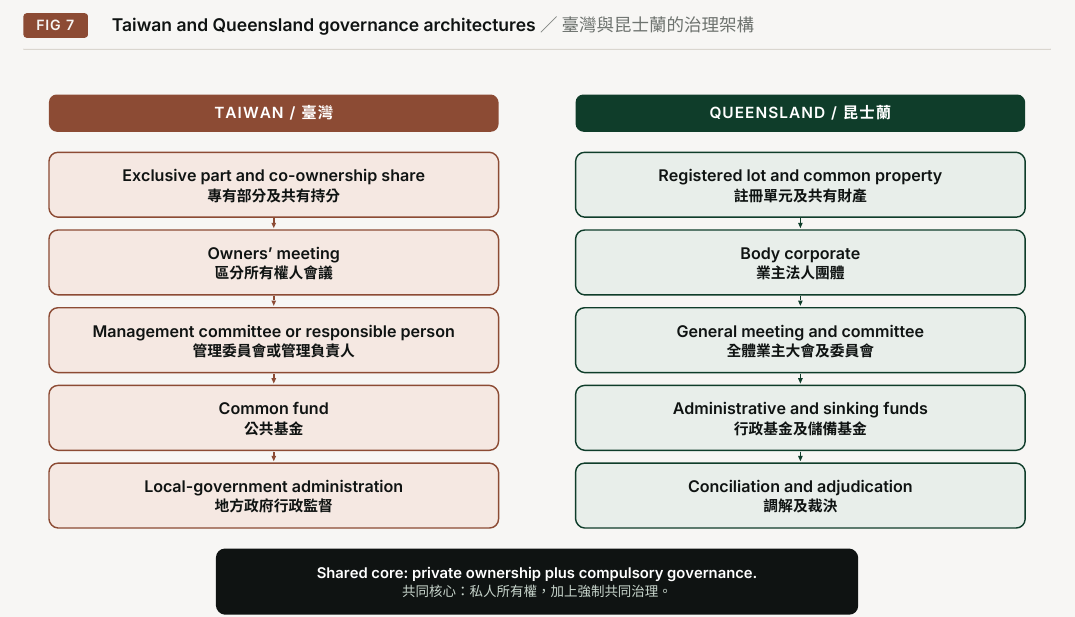
Taiwan and Queensland both combine separately owned property with compulsory collective administration, but similarity of function does not establish equivalence of legal form. This chapter compares the legal object owned, the collective decision-maker, the governing documents, funding, management and enforcement. A term used in one jurisdiction should not be substituted for a term in the other without first testing its legal effect.臺灣與昆士蘭均把個別所有的物業與強制集體行政管理結合,但功能相似並不表示法律形式相同。本章比較所有權的法律標的、集體決策者、治理文件、資金、管理及執法機制。任何一地的術語均不應直接代替另一地的術語,必須先檢驗其法律效果。
4.1Comparison at a glance比較概覽
比較概覽Comparison at a glance
| ISSUE議題 | TAIWAN臺灣 | QUEENSLAND昆士蘭 |
|---|---|---|
| Legal architecture法律架構 | National Civil Code plus the Condominium Administration Act; local government administration.以全國《民法》及《公寓大廈管理條例》為主,並由地方政府行政管理。 | State-based BCCM Act, registered CMS and a selected regulation module.以州級BCCM法、註冊CMS及選定規管模組構成。 |
| Collective entity集體組織 | Management committee or management responsible person; owners’ meeting remains central.管理委員會或管理負責人;區分所有權人會議居核心地位。 | Body corporate arises automatically and has legal capacity to act, contract, sue and be sued.業主法人團體自動成立,具行事、訂約、起訴及被訴能力。 |
| Common property共有財產 | Co-owned according to Civil Code and the building’s division; use governed by law and bylaws.依《民法》及建物區分共有;使用受法例及規約規管。 | Vested in the body corporate as agent for owners; boundaries depend heavily on survey-plan format.共有財產由業主法人團體代表業主持有;界線高度取決於測量圖則格式。 |
| Rules規則 | Community bylaws and meeting resolutions.規約及會議決議。 | Recorded CMS by-laws, subject to statutory limits and reasonableness.註冊CMS管理規約,受法定限制及合理性要求約束。 |
| Funds基金 | Common fund; developer contributes at establishment under the Act.公共基金;起造人須依法於成立時提撥。 | Administrative and sinking funds supported by annual budgets and levies.以年度預算及管理費維持行政基金與儲備基金。 |
| Managers管理人 | Professional management organisations/ personnel are licensed and regulated.專業管理公司及人員受許可與規管。 | Body corporate managers are not presently required to hold a specific body corporate manager licence; letting work is separately licensed.業主法人管理人目前毋須持有專門牌照;出租代理另受牌照規管。 |
| ISSUE議題 | TAIWAN臺灣 | QUEENSLAND昆士蘭 |
|---|---|---|
| Disputes爭議 | Administrative enforcement and court proceedings, with local authority involvement.行政執法與法院程序並行,地方主管機關可介入。 | Self-resolution, specialist conciliation/adjudication and limited QCAT/court pathways.先行自行協商,再由專門調解/裁決,部分事項進入QCAT或法院。 |
4.2Creation and title成立與產權
成立與產權Creation and title
Ownership is built from an exclusive part of the building, an associated share in common elements and the underlying land rights. The Condominium Administration Act regulates the community after division; Civil Code article 799 supplies the core divided-ownership concept.TAIWAN臺灣所有權由建築物專有部分、共有部分應有部分及相關基地權利組成。《公寓大廈管理條例》規管區分所有後的社區;《民法》第799條提供區分所有的核心概念。
A community titles scheme is established by registering the survey plan and CMS. The body corporate is created automatically and every lot owner becomes a member. Lot boundaries vary between building format, standard format and volumetric plans.QUEENSLAND昆士蘭社區產權項目透過註冊測量圖則及CMS成立。業主法人團體自動成立,每名單元業主均成為成員。單元界線會因建築格式、標準格式或空間體積式圖則而異。
4.3Foundational documents and governance基本文件與治理
基本文件與治理Foundational documents and governance
The owners’ meeting adopts bylaws, elects or appoints the management committee or responsible person and decides major community matters. Statutory voting rules include default thresholds and a reconvened-meeting mechanism.TAIWAN臺灣區分所有權人會議制定規約、選任管理委員會或管理負責人,並決定社區重大事項。法例設有預設表決門檻及重新召集會議機制。
The Act, module and CMS operate together. General meetings, committees and resolution classes allocate decision-making power. The body corporate and owners must act reasonably, and by-laws cannot override the Act.QUEENSLAND昆士蘭法例、規管模組及CMS共同運作。全體業主大會、委員會及不同決議類別分配決策權。業主法人團體及業主須合理行事,管理規約不得凌駕法例。
4.4Developer transition and handover開發商過渡與移交
開發商過渡與移交Developer transition and handover
After the statutory threshold of registered ownership is reached, the developer must convene the first owners’ meeting within the prescribed period. The Act also contains direct handover obligations for common facilities, documents and testing, with local-authority oversight.TAIWAN臺灣達到法定登記所有權門檻後,起造人須在規定期間內召開首次區分所有權人會議。法例亦直接規定共有設施、文件及檢測的移交義務,並由地方主管機關監督。
Under the Standard Module, the original owner calls the first annual general meeting (AGM) within two months after the earlier statutory trigger—generally when more than half the lots are transferred or six months passes after establishment. The original-owner control period carries disclosure, record and conflict safeguards.QUEENSLAND昆士蘭依標準規管模組,原始業主須在較早法定觸發點後兩個月內召開首次年度全體業主大會;一般為超過半數單元已轉讓,或項目成立滿六個月。原始業主管制期另設披露、紀錄及利益衝突保障。
4.5Money, maintenance and insurance財務、維修與保險
財務、維修與保險Money, maintenance and insurance
The developer must make an initial contribution to the common fund. Owners and the management organisation divide maintenance according to exclusive and common parts, subject to the Act, bylaws and defects. Insurance is less comprehensively prescribed within the condominium statute itself.TAIWAN臺灣公共基金用於共同義務,起造人須作初始提撥。業主與管理組織依專有及共有部分、法例、規約及過失分配維修責任。《公寓大廈管理條例》本身對整體保險的規定不及昆士蘭詳盡。
Bodies corporate budget for an administrative fund and sinking fund; the Standard Module uses a forward capital-expenditure horizon. Maintenance boundaries depend on plan format and utility infrastructure. Building and public-risk insurance obligations are detailed and usually include full replacement cover for relevant buildings.QUEENSLAND昆士蘭業主法人團體須編製行政基金及儲備基金預算;標準規管模組採用前瞻性資本開支預測。維修界線取決於圖則格式及公用設施。建築物與公眾責任保險義務較為詳盡,相關大廈通常須按全額重置價值投保。
4.6Managers, records and transparency管理人、紀錄與透明度
管理人、紀錄與透明度Managers, records and transparency
Professional condominium management organisations and personnel are subject to statutory licensing and qualification controls. The committee must keep and provide specified records, including meeting, accounting and maintenance materials.TAIWAN臺灣專業公寓大廈管理維護公司及人員受法定許可與資格管制。管理委員會須保存並提供指定紀錄,包括會議、會計及維修資料。
The body corporate must maintain extensive records and provide access on request and payment of the prescribed fee. A body corporate manager performs contracted administrative work but is not currently subject to a dedicated licensing regime. The authorised letting agent must hold the relevant property licence.QUEENSLAND昆士蘭業主法人團體須保存廣泛紀錄,並在書面申請及繳付規定費用後提供查閱。業主法人管理人按契約提供行政服務,但目前沒有專門牌照制度;獲授權出租代理人則須持有相關地產牌照。
4.7Rules, exclusive use and pets規則、專用使用與寵物
規則、專用使用與寵物Rules, exclusive use and pets
Community bylaws regulate use of exclusive and common parts within statutory boundaries. Decisions concerning shared areas must respect co-ownership rights and the Act’s mandatory provisions.TAIWAN臺灣規約在法定範圍內規管專有及共有部分的使用。涉及共有區域的決定須尊重共有權及法例的強制規定。
Exclusive-use by-laws can allocate use of defined common property but do not transfer ownership. Since the 2024 reforms, a by-law cannot impose a blanket prohibition on keeping animals; requests must be considered under statutory standards and within prescribed timeframes.QUEENSLAND昆士蘭專用使用管理規約可分配特定共有財產的使用權,但不轉移所有權。2024年改革後,管理規約不得全面禁止飼養動物;申請須按法定標準並在規定期限內審議。
4.8Enforcement, disputes and redevelopment執法、爭議與重建
執法、爭議與重建Enforcement, disputes and redevelopment
Serious and repeated breaches can lead to statutory enforcement, administrative penalties and, in exceptional cases, court-ordered compulsory sale or removal. Redevelopment usually interacts with broader urban-renewal, dangerous-building and co-ownership laws.TAIWAN臺灣嚴重或持續違規可引致法定執法、行政罰則;在特殊情況下,法院可命令強制出售或遷離。重建通常另涉及都市更新、危險建築及共有法律。
Most BCCM disputes move through self-resolution, conciliation and adjudication. The Act permits scheme termination by agreement and includes an economicreasons process requiring a detailed termination plan and at least 75% support of all lot owners, subject to challenge safeguards.QUEENSLAND昆士蘭大部分BCCM爭議依次經自行協商、調解及裁決處理。法例容許協議終止項目,亦設經濟原因終止程序,須有詳細終止計劃並獲全體單元業主至少75%支持,同時設有異議保障。
4.9Practical assessment實務評估
實務評估Practical assessment
Queensland has a more elaborate registered-governance architecture: the CMS, regulation modules, detailed budgets and insurance rules, layered schemes, disclosure documents and specialist dispute resolution. Taiwan provides stronger direct statutory regulation of professional managers, an initial developer-funded common fund, express handover duties and a visible administrative-enforcement role.昆士蘭具有較精細的註冊治理架構,包括CMS、規管模組、詳細預算與保險規則、分層級項目、披露文件及專門爭議處理。臺灣則在專業管理人規管、起造人初始提撥公共基金、明確移交義務及行政執法方面較為突出。
4.10Legal foundations and title structure法律基礎與產權結構
法律基礎與產權結構Legal foundations and title structure
Taiwan’s condominium ownership rests on Civil Code co-ownership principles together with the Condominium Administration Act. An owner holds an exclusive part and an inseparable share in common elements and the underlying land. Queensland creates a community titles scheme through a registered survey plan and CMS under state land-title legislation and the BCCM Act.臺灣的公寓大廈所有權以《民法》的共有原則及《公寓大廈管理條例》為基礎。區分所有權人持有專有部分,以及對共用部分與基地不可分離的應有部分。昆士蘭則依州級土地產權法例及BCCM法,透過註冊測量圖則及CMS成立社區產權項目。
Both systems combine exclusive ownership with compulsory common obligations, but the documentary expression differs. Queensland buyers must interpret plan format, lot boundaries, common property and CMS schedules. Taiwan buyers focus on the building registration, land share, exclusive and common parts, agreed exclusive-use or common-use areas, regulations and management records.兩地制度均把專有所有權與強制共同義務結合,但文件表達方式不同。昆士蘭買方須解讀圖則格式、單元界線、共有財產及CMS附表;臺灣買方則著重建物登記、基地持分、專有與共用部分、約定專用或約定共用部分、規約及管理紀錄。
- Review exclusive-use arrangements separately from ownership.
- Use local conveyancing terminology in each jurisdiction.
- 把專用使用安排與所有權分開審查。
- 在各司法管轄區使用當地產權交易術語。
4.11Collective organisations and legal personality集體組織與法律人格
集體組織與法律人格Collective organisations and legal personality
In Queensland, all lot owners automatically comprise the body corporate. The body corporate has statutory capacity for scheme functions and continues despite ownership changes. In Taiwan, owners exercise collective authority through the unit owners’ meeting, while day-to-day implementation is undertaken by a management committee or management responsible person.在昆士蘭,所有單元業主自動組成業主法人團體。該團體就項目職能具有法定能力,並不因業主更替而終止。在臺灣,區分所有權人透過區分所有權人會議行使集體權力,日常執行則由管理委員會或管理負責人承擔。
The practical question in both systems is authority: who validly decided, who may sign, and what approval threshold applies? A committee chairperson or body corporate manager does not acquire unlimited power merely because that person conducts administration. Contracts and major works should be traced back to the governing statute, regulations or bylaws and the relevant meeting resolution.兩地實務核心均是權限:由誰有效決定、誰可簽署,以及適用何種批准門檻。管理委員會主任委員或業主法人管理人不會因負責行政而取得無限權力。契約及重大工程應追溯至管治法例、規約或管理規約,以及相關會議決議。
4.12Meetings, voting and delegated decisions會議、表決與授權決策
會議、表決與授權決策Meetings, voting and delegated decisions
Queensland’s BCCM system divides decisions between the body corporate in general meeting and the committee, using resolution categories and procedural rules in the applicable module. Taiwan places central importance on the unit owners’ meeting, with the management committee implementing resolutions and carrying out responsibilities allocated by statute and the condominium regulations.昆士蘭BCCM制度按適用規管模組,把決策分配予全體大會及委員會,並採用不同決議類別及程序規則。臺灣則以區分所有權人會議為核心,由管理委員會執行決議及履行法例與規約分配的職責。
For cross-border readers, labels such as “ordinary resolution,” “special resolution,” quorum and entitlement should never be translated into assumed equivalents without checking the legal threshold. The relevant questions include notice, agenda disclosure, eligibility to vote, proxies or representatives, conflicts, required majorities and whether the decision must be recorded or registered.對跨境讀者而言,「普通決議」、「特別決議」、法定人數及權益等詞語,不可在未查核法律門檻前直接視為對等概念。須查明通知、議程披露、投票資格、代理或代表、利益衝突、所需多數,以及決定是否須記錄或登記。
4.13Funds, levies and capital planning基金、管理費與資本規劃
基金、管理費與資本規劃Funds, levies and capital planning
Taiwan’s Act requires a common fund and contemplates contributions from the developer and owners, with management and disclosure responsibilities. Queensland modules generally require administrative and sinking funds, annual budgets and owner contributions calculated by reference to the relevant lot-entitlement schedule, subject to statutory allocation rules.臺灣《公寓大廈管理條例》要求設置公共基金,並規定起造人及區分所有權人的資金來源,以及管理與公告責任。昆士蘭規管模組一般要求設置行政基金及儲備基金、編製年度預算,並按相關單元權益表及法定分攤規則向業主徵收款項。
The systems differ in prescriptiveness and terminology, but both confront the same economic risk: current owners may underfund assets whose replacement cost falls on future owners. A purchaser should compare cash on hand, recurring income, arrears, forecast capital work, insurance excesses and contractual commitments. A low levy can indicate efficiency, inadequate scope or deferred maintenance.兩地制度在規管細緻程度及術語上不同,但面對相同經濟風險:現任業主可能不足額撥備,令資產更換成本落在未來業主身上。買方應比較現金、經常收入、欠款、預測資本工程、保險自負額及契約承擔。低管理費可能代表效率高、服務範圍小,亦可能代表維修被延後。
4.14Maintenance and insurance allocation維修與保險責任分配
維修與保險責任分配Maintenance and insurance allocation
Queensland maintenance responsibility depends heavily on the registered plan format, lot boundaries, common property and utility infrastructure, with detailed module provisions. Body corporate building insurance can cover relevant buildings while owners still need contents, landlord and other personal policies. Taiwan relies on the distinction between exclusive and common parts, the Act, regulations and fault-based responsibility.昆士蘭的維修責任高度取決於註冊圖則格式、單元界線、共有財產及公用設施,並受規管模組詳細條文規定。業主法人團體的建築保險可涵蓋相關建築,但業主仍須安排家居財物、出租業主及其他個人保險。臺灣則依專有與共用部分的區分、法例、規約及歸責原則分配責任。
A cross-border owner should not assume that the committee repairs everything outside the apartment or that body corporate insurance covers internal contents and rent loss. Water ingress illustrates the need to separate the failed component, ownership boundary, maintenance duty, causation, insurance response and consequential damage. Several parties may be involved without having identical liability.跨境業主不應假設公寓外的一切均由管理組織維修,亦不應假設業主法人團體保險涵蓋室內財物及租金損失。滲水問題顯示必須分開分析失效構件、所有權界線、維修義務、因果關係、保險保障及後續損害。多方可能同時涉及,但責任並不相同。
4.15Managers, records and professional regulation管理人、紀錄與專業規管
管理人、紀錄與專業規管Managers, records and professional regulation
Taiwan regulates condominium management service organisations and personnel through a professional qualification framework. Queensland distinguishes body corporate managers, service contractors, caretaking service contractors and authorised letting agents. A dedicated body corporate-manager licence is not presently the centre of the Queensland model, although contractual duties and statutory codes apply.臺灣透過專業資格制度規管公寓大廈管理維護公司及人員。昆士蘭則區分業主法人管理人、服務承包商、管理維護服務承包商及獲授權出租代理人。昆士蘭制度目前並非以專門業主法人管理人牌照為核心,但契約責任及法定行為守則仍然適用。
Records are equally important. Queensland bodies corporate keep statutory records and provide access subject to process and fees. Taiwan management organisations must preserve and disclose specified management and financial materials. In both places, a buyer should go beyond summary certificates where risk justifies it and inspect primary records for decisions, disputes, contracts and arrears.紀錄在兩地同樣重要。昆士蘭業主法人團體須保存法定紀錄,並按程序及收費提供查閱;臺灣管理組織亦須保存及公開指定管理與財務資料。在兩地,如風險值得進一步調查,買方均不應只依賴摘要證明,而應審閱有關決策、爭議、契約及欠款的原始紀錄。
- Inspect the written appointment and delegated powers.
- Search source records rather than relying on verbal summaries.
- Review conflicts, commissions and related-party dealings.
- 審閱書面委任及授權權力。
- 查閱原始紀錄,不只依賴口頭摘要。
- 審閱利益衝突、佣金及關聯交易。
4.16Rules, pets and exclusive-use arrangements規則、寵物與專用使用安排
規則、寵物與專用使用安排Rules, pets and exclusive-use arrangements
Queensland by-laws recorded with the CMS regulate the use and enjoyment of lots and common property but remain subject to statutory limits and reasonableness requirements. Exclusive-use by-laws can allocate use of defined common property without transferring ownership. Taiwan condominium regulations and owners’ meeting resolutions operate within the mandatory provisions of the Act and Civil Code.昆士蘭隨CMS註冊的管理規約規管單元及共有財產的使用與享用,但仍受法定限制及合理性要求約束。專用使用管理規約可把指定共有財產的使用權分配予特定業主,卻不轉移所有權。臺灣公寓大廈規約及區分所有權人會議決議,則在《公寓大廈管理條例》及《民法》強制規定範圍內運作。
Pet regulation demonstrates the difference between a request process and an absolute prohibition. Queensland reforms restrict blanket prohibitions, but an owner should still follow the scheme’s application process and reasonable conditions. Parking, balconies, storage and signage likewise require the owner to distinguish title ownership, exclusive use, licence and mere informal tolerance.寵物規管顯示申請程序與絕對禁止之間的差異。昆士蘭改革限制全面禁養,但業主仍應遵守項目的申請程序及合理條件。泊車位、露台、儲物區及標誌亦同樣要求業主區分產權所有、專用使用、許可及單純非正式容忍。
4.17Disputes, handover and redevelopment爭議、交接與重建
爭議、交接與重建Disputes, handover and redevelopment
Queensland provides specialist conciliation and adjudication for many body corporate disputes, with QCAT or courts relevant in defined matters. Taiwan combines owners’ self-governance with administrative enforcement and ordinary court processes. The available remedy depends on the issue, parties, statutory pathway and urgency.昆士蘭就不少業主法人團體爭議提供專門調解及裁決程序,特定事項則可涉及QCAT或法院。臺灣把業主自治、行政執法及一般法院程序結合。可採用的補救取決於爭議事項、當事人、法定途徑及緊急程度。
Developer handover and ageing-building redevelopment expose structural differences. Taiwan’s Act contains specific handover responsibilities and a developer-funded initial common fund. Queensland uses original-owner obligations, disclosure, meetings, records and the scheme’s funds, and now includes an economic-reasons termination pathway subject to detailed safeguards.開發商交接及老舊大廈重建突顯兩地結構差異。臺灣法例訂有特定交接責任及由起造人提列的初始公共基金;昆士蘭則透過原始業主義務、披露、會議、紀錄及項目基金運作,並新增受詳細保障約束的經濟原因終止途徑。
This chapter is general educational information, not legal, financial, tax, building or investment advice. Outcomes turn on the particular contract, title, survey plan, community management statement, applicable regulation module and the law in force at the relevant time. Obtain independent Queensland legal advice before signing a contract, waiving a condition, settling, or buying management rights. Where the English and Chinese texts differ, the English text governs. 本章僅提供一般教育資訊,並非法律、財務、稅務、建築或投資意見。法律結果取決於個別契約、產權、測量圖則、社區管理聲明、適用的規管模組,以及相關時間的現行法例。簽署契約、放棄條件、辦理交割或購買管理權前,應取得獨立的昆士蘭法律意見。如中英文本有異,概以英文為準。