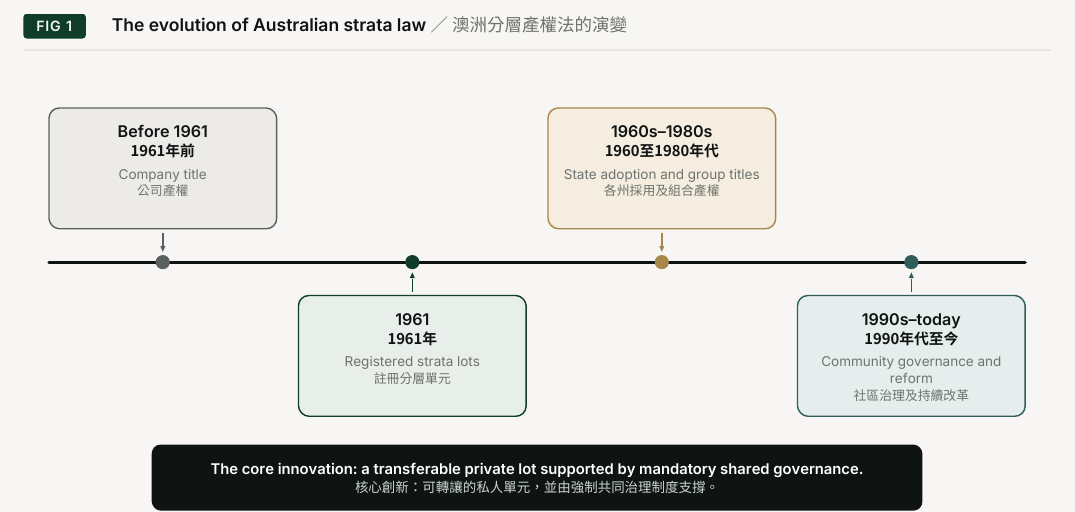
Statutory strata title converts a defined part of a building into land capable of separate ownership, transfer and mortgage, while preserving compulsory rights and obligations in relation to the balance of the property. Before that legislation, company title commonly gave the purchaser shares and a contractual occupation right, not a separate registered title to the apartment. The history is therefore the history of a legal technique developed to combine individual ownership with collective administration.法定分層產權把建築物中明確界定的部分轉化為可獨立擁有、轉讓及抵押的土地,同時保留對其餘物業的強制權利及義務。在相關立法出現以前,公司產權通常只給予買方股份及契約上的佔用權,而不是公寓本身的獨立註冊產權。因此,這段歷史實質上是法律如何把個別所有權與集體行政管理結合起來的發展史。
1.1The 1961 breakthrough1961年的突破
1961年的突破The 1961 breakthrough
New South Wales enacted the Conveyancing (Strata Titles) Act 1961, widely recognised as the first modern strata-title statute. It allowed a registered plan to create individually transferable lots and common property, supported by collective management. The model was commercially important because a lot could be mortgaged and conveyed as land, making apartment ownership easier to finance.新南威爾斯州於1961年制定《物業轉讓(分層產權)法》,普遍被視為首部現代分層產權法例。註冊圖則可劃分可獨立轉讓的單元及共有財產,並設立集體管理機制。由於單元可如土地般抵押及轉讓,公寓購置更容易取得融資,因而具有重大商業意義。
1.2National adoption and local variation全國採用與地方差異
全國採用與地方差異National adoption and local variation
Other states and territories adopted their own unit, strata or group-title statutes through the 1960s and 1970s. The shared architecture was similar—registered lots, common property, compulsory membership and levies—but terminology, voting, maintenance boundaries, disclosure and dispute forums developed differently. There is no single Australian strata Act.其他州及領地在1960至1970年代先後制定各自的單元、分層或組合產權法例。共同架構大致相似,包括註冊單元、共有財產、強制成員資格及管理費;但術語、投票、維修界線、披露及爭議處理機制各有發展。澳洲並不存在一部全國統一的分層產權法。
1.3From apartment blocks to communities從公寓大廈到社區
從公寓大廈到社區From apartment blocks to communities
- Early schemes focused on vertical apartment buildings.
- Group and community-title laws later accommodated townhouses, shared roads and staged estates.
- 早期制度主要處理垂直式公寓大廈。
- 其後的組合及社區產權法容納了聯排住宅、共用道路及分期發展屋苑。
- Layered and mixed-use structures enabled residential, retail, hotel and marina components to share infrastructure.
- Modern reforms increasingly address consumer disclosure, building defects, sustainability, pets, electronic meetings and redevelopment of ageing schemes.
- 分層級及混合用途架構,使住宅、零售、酒店及遊艇碼頭可共用基礎設施。
- 現代改革日益關注消費者披露、建築缺陷、可持續發展、寵物、電子會議及老舊項目重建。
1.4The enduring legal bargain持續存在的法律平衡
持續存在的法律平衡The enduring legal bargain
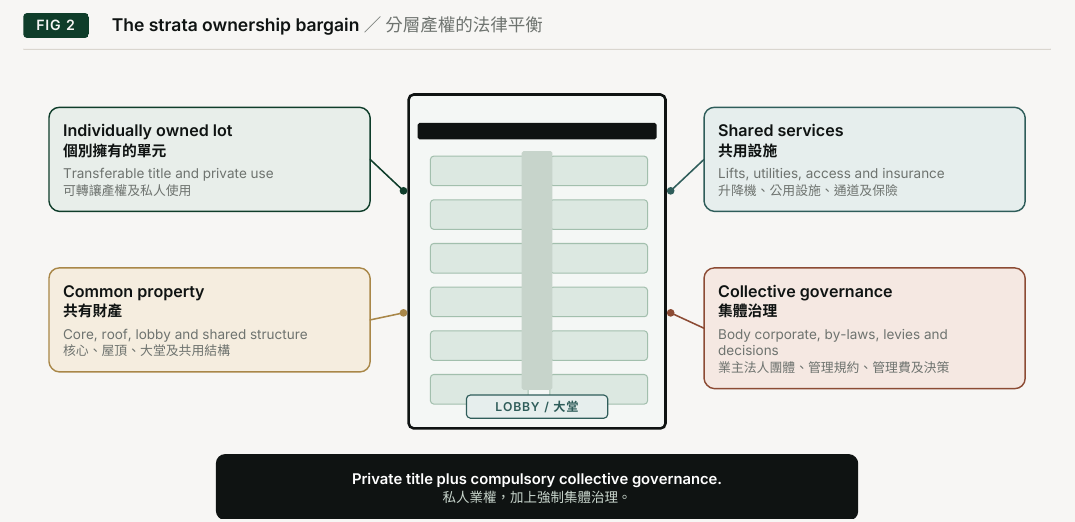
Strata ownership combines private title with mandatory collective governance. An owner gains a marketable lot but accepts by-laws, levies, shared maintenance and majority decision-making. Most recurring disputes—noise, pets, parking, repairs, insurance and expenditure—flow from the tension between individual autonomy and collective responsibility.分層產權把私人業權與強制集體治理結合。業主取得可買賣的單元,同時須接受管理規約、管理費、共同維修及多數決策。噪音、寵物、泊車、維修、保險及支出等常見爭議,均源自個人自主與集體責任之間的張力。
1.5Company title before strata分層產權前的公司產權
分層產權前的公司產權Company title before strata
Before statutory strata title, many Australian apartment buildings used company title. A company owned the whole land and building; each resident acquired shares carrying a contractual right to occupy a nominated apartment. The occupier therefore owned personal property—the shares—rather than a separately registered freehold lot.在法定分層產權出現以前,澳洲不少公寓大廈採用公司產權。公司持有整幅土地及大廈,每名住戶購入與指定公寓佔用權相連的公司股份。因此,住戶擁有的是作為動產的股份,而不是獨立註冊的永久業權單元。
The model could work, but it depended heavily on the company constitution, occupancy agreement and directors. Transfers, leasing and renovations might require company approval. Mortgage finance was more difficult because the lender did not receive a conventional registered mortgage over the apartment. These constraints created the commercial demand for legislation that could turn a three-dimensional part of a building into transferable land while preserving collective control of shared areas.公司產權可以運作,但高度依賴公司章程、佔用協議及董事決策。轉讓、出租及裝修可能需要公司批准。由於貸款人不能就公寓取得傳統註冊抵押,融資亦較困難。這些限制促成了立法需求:把大廈內三維空間轉化為可轉讓土地,同時保留對共用地方的集體管理。
- Check whether liabilities attach to the company as well as the occupier.
- 查明責任是否同時由公司及佔用人承擔。
1.6The legal innovation of the 1961 model1961年制度的法律創新
1961年制度的法律創新The legal innovation of the 1961 model
The New South Wales legislation enacted in 1961 separated ownership vertically and horizontally by reference to a registered strata plan. It connected three elements that had previously been difficult to combine: an individually transferable lot, an inseparable interest in common property, and a statutory collective body responsible for administration.新南威爾斯州於1961年制定的法例,透過註冊分層圖則把所有權按垂直及水平空間劃分。該制度結合了過往難以並存的三項元素:可獨立轉讓的單元、不可分割的共有財產權益,以及負責行政管理的法定集體組織。
This architecture made an apartment recognisable to the land-titles and mortgage systems. Registration supplied certainty about the lot, while the statutory organisation supplied continuity when owners changed. The key insight was that private ownership and compulsory community governance are not alternatives: they must operate together. That insight remains visible in every modern Australian strata or communitytitle regime.此架構令公寓可被土地登記及抵押制度辨識。註冊確定單元範圍;法定組織則在業主更替時維持治理延續。其核心創見在於:私人所有權與強制社區治理並非二選一,而必須並行。現代澳洲所有分層或社區產權制度仍沿用此理念。
1.7National adoption without national uniformity全國採用但並非全國統一
全國採用但並非全國統一National adoption without national uniformity
The 1961 concept spread across Australia, but each state and territory enacted and repeatedly revised its own legislation. The result is a family of related systems rather than one national code. Similar buildings can therefore have materially different meeting rules, maintenance boundaries, disclosure obligations, terminology and dispute forums depending on location.1961年的制度概念其後傳遍澳洲,但各州及領地分別制定並多次修訂本身法例。結果形成一組相近制度,而非一部全國法典。因此,即使大廈外觀相似,其會議規則、維修界線、披露義務、術語及爭議處理機關亦可能因所在地而有重大差異。
New South Wales now separates development and management legislation; Victoria uses an owners-corporations framework; Western Australia substantially modernised its strata legislation; South Australia distinguishes strata and community titles; and Queensland organises most modern schemes through the BCCM Act and regulation modules. Federal laws still intersect—tax, corporations, competition, privacy and migration rules may matter—but they do not replace the state land-title regime.新南威爾斯州現把發展與管理法例分開;維多利亞州採用業主立案法團制度;西澳洲大幅現代化其分層產權法;南澳洲區分分層及社區產權;昆士蘭則主要透過BCCM法及規管模組管理現代項目。聯邦稅務、公司、競爭、私隱及移民法例可能同時適用,但不會取代州級土地產權制度。
1.8Reform waves and the modern policy agenda改革浪潮與現代政策方向
改革浪潮與現代政策方向Reform waves and the modern policy agenda
Australian strata legislation has moved through recurring reform waves. The first wave created registrable lots. The second accommodated horizontal estates, staged development and layered communities. Later reforms strengthened financial governance, records, consumer disclosure, dispute resolution and controls on long-term service arrangements.澳洲分層產權立法經歷多輪改革。第一輪建立可註冊單元;第二輪容納橫向屋苑、分期發展及分層級社區;其後改革則加強財務治理、紀錄、消費者披露、爭議處理及長期服務安排的規管。
Current policy pressures arise from ageing buildings, combustible cladding and other defects, rising insurance premiums, climate resilience, electric-vehicle charging, embedded networks, short-term letting, accessibility, pets and redevelopment/scheme termination. The legal system must allocate cost and decision-making power across owners who may have different time horizons. An investor, resident owner, developer and mortgagee may all assess the same proposal differently.現時政策壓力源自老舊大廈、可燃外牆及其他缺陷、保費上升、氣候韌性、電動車充電、內嵌網絡、短期出租、無障礙設施、寵物及重建。法律制度必須在持有期不同的業主之間分配成本及決策權;投資者、自住業主、開發商及抵押權人對同一方案可能有不同評價。
This chapter is general educational information, not legal, financial, tax, building or investment advice. Outcomes turn on the particular contract, title, survey plan, community management statement, applicable regulation module and the law in force at the relevant time. Obtain independent Queensland legal advice before signing a contract, waiving a condition, settling, or buying management rights. Where the English and Chinese texts differ, the English text governs. 本章僅提供一般教育資訊,並非法律、財務、稅務、建築或投資意見。法律結果取決於個別契約、產權、測量圖則、社區管理聲明、適用的規管模組,以及相關時間的現行法例。簽署契約、放棄條件、辦理交割或購買管理權前,應取得獨立的昆士蘭法律意見。如中英文本有異,概以英文為準。